Why Swiss SMEs should automate their accounting in 2026
Many SMEs lose time every day through manual processes. This article shows how modern business software simplifies administration, banking and accounting.
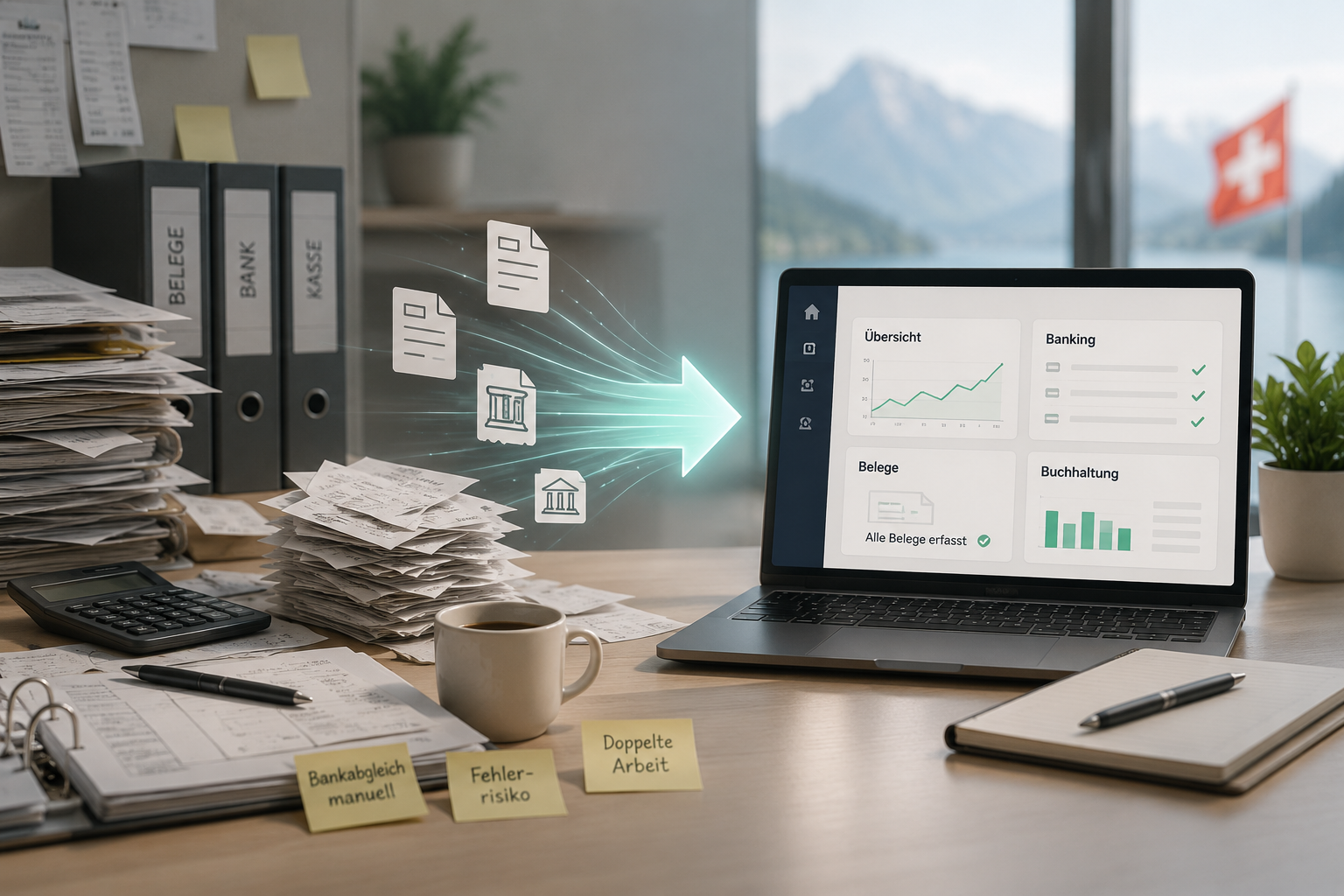
Many Swiss SMEs still work with scattered Excel files, paper receipts, manual bank reconciliations and several standalone tools. This not only costs time but also increases the risk of errors, manual handoffs and duplicate work.
Smaller companies in particular need a simple, modern and integrated solution today that connects administration, banking and accounting.
This is exactly where Saldio comes in.
The daily reality for many SMEs
In many companies the workflow today still looks similar:
- quotes are written in Word
- invoices created separately
- payments reconciled manually in online banking
- receipts printed out or searched for by email
- bookings sometimes entered twice
- Excel files serve as additional controls
As a company grows, so does the administrative effort.
This becomes especially problematic with:
- several employees
- recurring invoices
- open accounts receivable
- project and time reporting
- missing reports
- year-end closings and VAT returns
What modern software should deliver today
Modern business software should not just enable accounting.
It should connect processes.
The goal is an end-to-end workflow:
Order → Service → Invoice → Payment → Booking
This results in fewer manual handoffs and significantly less manual work.
Important features today include for example:
- automatic QR invoice recognition
- bank reconciliation via CAMT files
- digital document storage
- simple quote and invoice creation
- integrated accounting
- VAT reports
- role and user management
- cloud-based access
Why automation is especially important for small companies
Many people first think of large enterprises when it comes to automation.
In reality, smaller SMEs benefit particularly strongly.
Because:
- few employees often take on many roles at once
- administration runs alongside day-to-day operations
- skilled staff are expensive
- there is no time for manual work
Every hour saved means more time for customers, projects and growth.
Typical savings in daily operations
Even simple automations can make a big difference:
| Area | Typical improvement |
|---|---|
| Invoice creation | less manual entry |
| Payment reconciliation | faster matching of payments |
| Accounting | fewer duplicate bookings |
| Document storage | faster retrieval of receipts |
| Year-end closing | better overview and preparation |
| VAT | simpler reporting and control |
In addition, transparency across the company increases.
Open invoices, liquidity and current business figures are available at any time.
Why many ERP systems are too complex for SMEs
Many classic ERP solutions were originally developed for larger enterprises.
The result:
- complicated rollout
- high training effort
- overloaded interfaces
- long projects
- high costs
Many SMEs therefore want a leaner alternative.
A solution that is modern but still stays simple.
The Saldio approach
Saldio was developed specifically for Swiss SMEs.
The focus is on:
- ease of use
- clear processes
- high automation
- modern cloud technology
- integrated accounting
- practical features for Swiss companies
Instead of connecting many standalone tools, Saldio combines central business processes in one system.
Conclusion
Digitizing administration is no longer a topic for the future.
SMEs today need solutions that simplify processes and reduce administrative work.
Anyone who intelligently connects quotes, invoices, banking and accounting saves time, reduces errors and creates a better overview of the company.
Saldio follows exactly this approach:
From order to balance.